When Was My Glock Made? How to Identify Your Glock’s Manufacturing Date
Buying a Glock without knowing its production year leaves many owners curious about the pistol’s history, generation, and factory details. Questions like when was my glock made often come up after checking the serial number or comparing design features with newer models. The manufacturing date can reveal important information about upgrades, parts compatibility, and overall value.
Many Glock owners use the production date to identify their handgun’s generation and confirm whether it includes certain factory improvements. Older models may have different finishes, internal parts, or magazine designs compared to newer releases. Knowing the timeline also helps during resale, maintenance, or collecting.
Searching for when was my glock made becomes easier once you understand how Glock serial numbers and proof marks work. A few letters or markings can quickly point to the production period and help you learn more about your firearm.
Whether you recently purchased a used Glock or owned one for years, learning its manufacturing date gives you a clearer picture of its background and authenticity.
Why Knowing Glock’s Manufacturing Date Matters
Understanding the manufacturing date of a Glock gives owners valuable insight into the pistol’s history, design updates, and factory specifications. Many Glock models have gone through changes over the years, including improvements to barrels, frames, triggers, and finishes. Knowing the production period helps identify what features came standard with the firearm and whether certain upgrades were introduced after it was made.
Better Understanding of Glock Generations
Glock pistols have evolved through several generations, and each version includes unique design features and performance improvements. Knowing the manufacturing date helps determine whether the firearm belongs to Gen 2, Gen 3, Gen 4, or Gen 5. This becomes especially important when purchasing accessories, magazines, or replacement parts because not every component fits every generation.
Older Glock models may lack features such as interchangeable backstraps, ambidextrous controls, or enhanced recoil systems. A manufacturing date can also explain why two Glock pistols with the same model number may look or perform differently. Collectors and enthusiasts often use production dates to identify rare or early-production versions that hold historical or collector value.
The manufacturing period also helps owners understand the engineering changes Glock introduced over time. Some production years included updated extractors, modified slides, or revised grip textures. These details matter to people who want a pistol configured in a specific way.
Helps Verify Authenticity and Parts Compatibility
Checking the manufacturing date can help confirm whether a Glock is authentic and whether its parts match the original factory setup. Many used pistols have aftermarket modifications or swapped internal components, which may affect reliability or safety. Comparing the production date with the firearm’s features helps owners spot inconsistencies more easily.
Certain Glock parts are designed only for specific generations or production periods. Recoil springs, barrels, magazines, and slides may not function correctly across every model variation. Knowing when the pistol was made reduces the chances of purchasing incompatible accessories or replacement parts.
The manufacturing date also becomes useful during repairs or upgrades. Gunsmiths often rely on production details to determine which internal parts were originally installed. This information can prevent installation errors and improve long-term firearm performance.
Buyers in the used firearm market also pay attention to production years. Some Glock manufacturing periods are considered more desirable because of factory finishes, internal configurations, or reliability updates. Having accurate production information can increase buyer confidence during resale or trade discussions.
Where To Find the Serial Number on a Glock
The serial number on a Glock provides important information about the firearm’s identity, production history, and registration records. Glock places serial numbers in multiple locations on the pistol to help confirm authenticity and ensure all major components match. Learning where these markings appear makes it easier to identify the firearm correctly when checking its manufacturing date or verifying ownership details.
Serial Number Located on the Frame
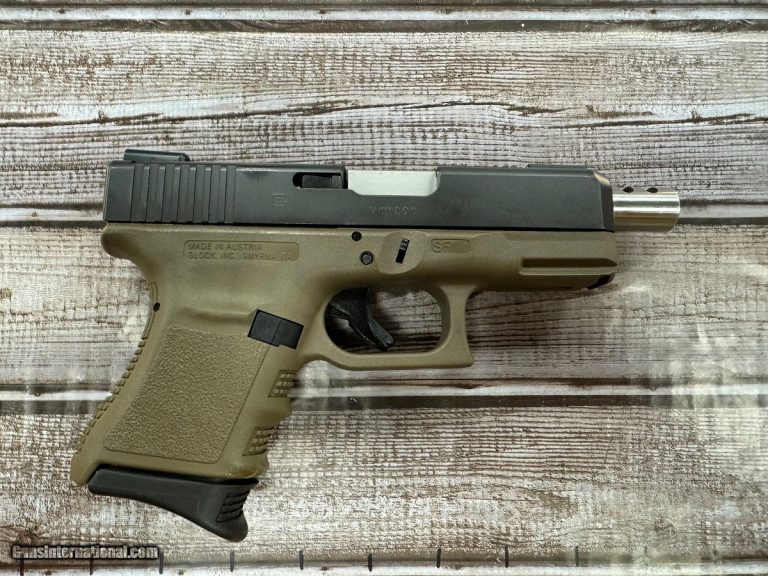
One of the easiest places to find the serial number on a Glock is the frame of the pistol. On most models, the serial number appears on a metal plate embedded into the lower portion of the frame near the trigger guard. This area is visible without disassembling the firearm, making it the quickest location to inspect.
The frame serial number is often the primary identification marking used during registration, transfers, and law enforcement checks. Owners frequently use this number when researching the firearm’s manufacturing date or verifying warranty information. Since the frame is legally considered the actual firearm in many countries, this serial number carries the most importance.
Carefully checking the frame also helps identify signs of tampering or damage. Uneven engraving, scratched surfaces, or mismatched markings may indicate alterations that deserve closer attention. A clean and matching serial number is usually a good sign that the pistol remains in original condition.
Matching Numbers on the Slide and Barrel
Glock pistols also include matching serial numbers on the slide and barrel. To view these markings, the firearm usually needs partial disassembly following proper safety procedures. The serial number on the slide is commonly located on the underside near the front portion, while the barrel number appears on the exposed metal section visible through the ejection port or after removal.
Matching numbers across the frame, slide, and barrel indicate the pistol likely retains its original factory parts. This matters to collectors, buyers, and firearm owners who want confirmation that the gun has not been rebuilt using mixed components from different pistols.
Serial number consistency can also affect resale value and reliability. Many buyers prefer Glock pistols with all original matching parts because they are viewed as more authentic and potentially more dependable. Gunsmiths and firearm dealers often inspect these markings during evaluations or trade-ins.
How To Determine When Your Glock Was Made
Finding the manufacturing date of a Glock helps owners learn more about the pistol’s generation, factory features, and production history. Glock does not print the exact production date directly on the firearm, but several markings and serial number details can help narrow it down. Understanding these identification methods makes it easier to verify authenticity and compare your pistol with different production periods.
Use the Glock Serial Number Lookup Method
The most common way to determine when a Glock was made is by checking the serial number. Glock serial numbers contain letter prefixes and number combinations that correspond to specific production periods. Owners often use online Glock serial number charts or firearm databases to compare these prefixes with known manufacturing timelines.
The serial number can usually be found on the frame, slide, and barrel of the pistol. Matching numbers across all three parts help confirm the firearm still has its original factory components. Once the serial number is identified, it becomes easier to estimate the year or production range of the handgun.
Some Glock enthusiasts also use archived production records and collector forums to compare serial prefixes with known release dates. Early-production Glocks often have unique serial ranges that collectors recognize quickly. This process may not provide the exact day the pistol was made, but it usually narrows the production year quite accurately.
Check the Barrel Proof Marks and Factory Features
Another useful method for identifying a Glock’s manufacturing period involves examining the barrel proof marks and factory features. Glock barrels often include proof symbols, country markings, and inspection stamps that changed slightly over different production years. These details can reveal whether the pistol belongs to an older or newer manufacturing batch.
Factory design features also provide strong clues about production dates. Grip texture, finger grooves, accessory rails, and slide finishes changed over multiple Glock generations. For example, older Gen 2 models lack finger grooves, while later generations include more aggressive texturing and updated recoil systems.
Owners can compare these physical characteristics with official Glock generation timelines and product photos. Many firearm collectors rely on these visual differences when serial number information alone does not provide enough detail.
Packaging and factory labels may also help determine the production period. Original Glock cases sometimes include labels with manufacturing codes, test-fire dates, or import information. These small details become valuable when researching older pistols or verifying collector models.
Glock Generations and Production Timeline
Glock pistols have evolved through multiple generations since the company introduced its first handgun in the early 1980s. Each generation brought design updates, internal improvements, and new features that changed the way the pistols performed and felt. Understanding the Glock production timeline helps owners identify their firearm more accurately and recognize the differences between older and newer models.
First and Second Generation Glock Models
The first Glock pistols appeared during the early 1980s with a simple polymer frame design that quickly gained attention for reliability and lightweight construction. Early first-generation models featured smooth grip surfaces without checkering or finger grooves. These pistols were produced in smaller numbers compared to later generations, making them more collectible today.
Second-generation Glock models arrived a few years later with improved grip texturing and front strap checkering for better handling. The overall appearance remained fairly simple, but the added texture gave shooters more control during firing. Many law enforcement agencies adopted second-generation Glock pistols because of their durability and consistent performance.
During this production period, Glock expanded its lineup by introducing additional calibers and compact models. Serial number ranges from these years are commonly used by collectors to identify early-production firearms. Owners researching manufacturing dates often compare grip styles and frame textures to determine whether their pistol belongs to the first or second generation.
Third Generation Glock Production Changes
Third-generation Glock pistols became some of the most widely recognized models in the company’s history. Introduced during the late 1990s, Gen 3 models added finger grooves, thumb rests, and an accessory rail on the frame. These changes gave the pistols a more modern appearance and improved functionality for tactical accessories such as lights and lasers.
Gen 3 Glock pistols remained in production for many years, making them one of the longest-running generations Glock ever produced. The company also introduced multiple caliber variations and specialized models during this time. Many shooters still prefer Gen 3 pistols because of their simplicity and broad aftermarket support.
The production timeline of Gen 3 models included several internal updates as well. Glock revised extractors, locking blocks, and frame configurations throughout the generation’s lifespan. Owners checking manufacturing dates often notice small differences between early and late Gen 3 pistols even within the same model number.
Because of the long production run, serial number identification became especially important for determining exact manufacturing periods. Some Gen 3 pistols were produced alongside later generations, which can occasionally create confusion for newer Glock owners.
Gen 4 and Gen 5 Glock Evolution
Fourth-generation Glock pistols introduced major ergonomic improvements compared to earlier versions. Released around 2010, Gen 4 models featured interchangeable backstraps, rough textured frames, and dual recoil spring assemblies. These updates improved recoil control and allowed shooters to customize grip size more easily.
Glock also enlarged the magazine release on Gen 4 pistols, making reloads faster and more comfortable for many users. The company designed these changes partly in response to feedback from law enforcement agencies and civilian shooters. Gen 4 models quickly became popular because they balanced modern upgrades with the reliability Glock was already known for.
Gen 5 Glock pistols later introduced another round of design changes, including the removal of finger grooves and the addition of improved internal components. Glock also enhanced barrel accuracy and added ambidextrous slide stop controls on many Gen 5 models. These pistols often feature a smoother grip design and revised slide finishes.
The production timeline of Gen 5 pistols continues today, with Glock regularly expanding the lineup through new model releases and limited variations. Manufacturing dates for newer Glock models are often easier to narrow down because of clearer generation features and updated serial number tracking systems.
Common Signs That Reveal an Older Glock
Older Glock pistols often have visual and mechanical details that separate them from newer production models. Glock changed many features over the years, including grip texture, frame design, slide finish, and internal components. Recognizing these differences helps owners estimate the firearm’s production period and understand which generation the pistol likely belongs to without relying only on serial number research.
Smooth Grip Texture and Lack of Finger Grooves
One of the easiest ways to identify an older Glock is by examining the grip texture and frame design. Early Glock models, especially first-generation pistols, featured smooth grip surfaces with very limited texturing. These frames lacked the aggressive patterns and ergonomic shaping found on modern versions.
Second-generation Glock pistols introduced checkering on the front and back straps, but they still did not include finger grooves. Finger grooves first appeared on Gen 3 models, making their absence a strong clue that the firearm was produced during an earlier period. Many collectors immediately recognize older Glock frames because of their simpler appearance.
The lack of interchangeable backstraps can also reveal an older production model. Modern Gen 4 and Gen 5 pistols allow shooters to customize grip size, while earlier generations maintain a fixed grip design. Comparing these frame features often provides a quick estimate of the pistol’s age.
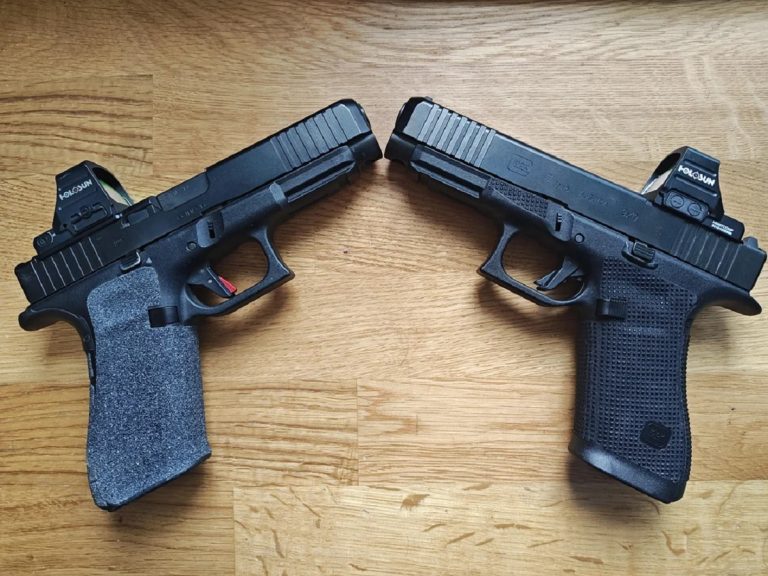
Older grip designs also tend to have slimmer profiles and less aggressive textures compared to modern duty-style Glock pistols. These visual differences become more noticeable when older and newer generations are placed side by side.
Older Slide Finishes and Original Factory Features
Slide finish is another common sign that reveals an older Glock. Early Glock pistols used a darker matte-style finish that differs from the coatings found on many newer models. Over time, Glock updated its slide treatments to improve corrosion resistance and durability, creating visible changes in texture and appearance.
Older Glock pistols may also lack accessory rails on the frame. Modern Glock handguns commonly include rails for mounting lights or lasers, but earlier generations were designed before tactical accessories became standard equipment. A smooth dust cover without a rail usually points toward an older production period.
The style of markings and logos on the slide can also help identify older Glock models. Earlier pistols often used slightly different engraving patterns and proof marks compared to current production firearms. Collectors sometimes use these small details to narrow down the manufacturing timeline more accurately.
Magazine design may reveal additional clues about age as well. Older Glock magazines often have different follower styles, base plates, and notch configurations compared to newer versions. These small factory features help distinguish earlier Glock production years from more recent models.
Best Resources for Glock Identification
Identifying a Glock correctly becomes much easier when using trusted resources designed for serial number research, generation comparisons, and factory feature verification. Glock owners often rely on a combination of official information, collector communities, and firearm databases to learn more about their pistol’s production history. These resources help confirm manufacturing periods, original configurations, and important generation-specific details.
Official Glock Manuals and Factory Information
Official Glock manuals remain one of the most reliable resources for identifying Glock models and features. Factory manuals often include diagrams, part references, and descriptions that help owners compare their firearm with original specifications. These documents can reveal differences between generations, calibers, and frame configurations.
Many Glock pistols also include factory labels or packaging with product codes and serial information. These labels may contain import details, model variations, and production references that help narrow down the manufacturing timeline. Owners who still have the original case and paperwork often find identification much easier.
Glock’s official support channels may also provide limited assistance for serial number verification or product identification. Some owners contact Glock customer service to confirm manufacturing details or learn about original factory configurations. This approach becomes especially useful for rare or older Glock models.
Factory resources are often considered the most accurate because they come directly from the manufacturer. Collectors and firearm enthusiasts frequently compare official records with serial number charts to verify authenticity and confirm historical details.
Online Glock Serial Number Databases and Forums
Online serial number databases are among the most popular resources for Glock identification. Many firearm enthusiasts maintain charts that match serial number prefixes with estimated production years. These tools allow owners to quickly compare their Glock serial number against known manufacturing ranges.
Glock forums and firearm communities also provide valuable information about specific production periods and rare model variations. Experienced collectors often recognize unique frame designs, proof marks, and slide features that newer owners may overlook. Discussions in these communities can help confirm whether a Glock belongs to an early production run or a later generation.
Some online databases include detailed generation timelines, factory changes, and historical production notes. Owners researching older Glock pistols often rely on these resources to identify small differences in grip texture, extractor designs, or slide finishes.
Photographs shared by other collectors can also help with comparison research. Seeing verified examples from different generations makes it easier to spot design changes and estimate when a particular Glock was produced.
Gun Shops, Collectors, and Certified Gunsmiths
Local gun shops and certified gunsmiths are also valuable resources for Glock identification. Many firearm professionals have years of experience handling different Glock generations and can often estimate a pistol’s production period simply by examining its frame and slide features.
Collectors who specialize in Glock pistols may recognize uncommon serial ranges, discontinued configurations, or rare import markings. Their experience becomes especially useful when researching older models that are no longer widely available. Some collectors maintain personal records and reference guides built from years of studying Glock production history.
Gunsmiths can also inspect internal components to identify generation-specific changes. Parts such as recoil spring assemblies, trigger housings, and extractors often reveal whether a Glock has original factory internals or upgraded components from later years.
Professional inspections may also uncover mismatched parts or aftermarket modifications that affect identification accuracy. Combining expert opinions with serial number research usually provides the clearest understanding of a Glock’s manufacturing timeline and originality.
FAQs
How Can You Tell When Your Glock Was Made?
You can usually determine when your Glock was made by checking the serial number located on the frame, slide, and barrel. The serial number contains letter prefixes that correspond to specific production periods. Many Glock owners compare these prefixes with online Glock serial number charts to estimate the manufacturing year.
You may also identify the production period by looking at generation features such as finger grooves, accessory rails, and grip texture. Older models often have smoother grips and fewer modern design upgrades. Combining serial number research with physical features gives you a more accurate estimate of your Glock’s age.
Where Is The Serial Number Located On A Glock?
You can find the serial number on several parts of your Glock pistol. The most visible location is the metal plate embedded into the lower frame near the trigger guard. Glock also places matching serial numbers on the slide and barrel for identification purposes.
Checking all three locations helps confirm the firearm still has its original factory parts. Matching numbers are important for collectors and buyers because they increase authenticity and resale value. You should always inspect the markings carefully to make sure they appear clean and untampered before researching the manufacturing date.
Can A Glock Serial Number Reveal The Exact Manufacturing Date?
A Glock serial number usually helps narrow down the manufacturing year or production period rather than revealing the exact day the pistol was made. Glock does not publicly provide full production date records for every serial number range, so most owners rely on serial prefix charts and collector databases.
You can often estimate the manufacturing timeline quite accurately by combining serial number information with generation features. Details like frame texture, slide finish, and barrel markings can help confirm whether your Glock belongs to a specific production era. This method works especially well for identifying older Glock models.
What Features Help Identify An Older Glock?
Older Glock pistols often have smoother grip textures, no finger grooves, and simpler frame designs compared to modern models. First-generation Glocks lacked many of the ergonomic upgrades found on newer pistols. Second-generation models added light texturing but still did not include accessory rails or interchangeable backstraps.
You may also notice differences in slide finish and factory markings on older pistols. Early Glock models used darker matte-style coatings and slightly different logo engravings. Magazine design can also reveal age because older magazines often feature different follower shapes and base plate styles than newer versions.
Why Does Glock Generation Matter When Identifying Production Dates?
Glock generations help you estimate when your pistol was produced because each generation introduced specific design updates. Gen 3 pistols added finger grooves and accessory rails, while Gen 4 models introduced interchangeable backstraps and dual recoil springs. Gen 5 pistols later removed finger grooves and improved internal components.
You can compare your Glock’s physical features with known generation timelines to identify its production period more accurately. This information also helps you choose compatible magazines, replacement parts, and accessories. Many firearm owners use generation details to verify authenticity and understand the history of their Glock pistol.
Can You Identify A Glock Without The Original Box?
You can still identify a Glock even without the original case or paperwork. The serial number on the firearm itself remains the most important detail for determining production history. Checking the frame, slide, and barrel markings usually provides enough information to begin researching the manufacturing timeline.
You may also use visual clues such as grip texture, slide design, and generation-specific features to narrow down the production period. Online Glock forums, serial number databases, and firearm collectors often help owners identify pistols without factory packaging. Original boxes help, but they are not required for basic Glock identification.
Do Matching Serial Numbers Matter On A Glock?
Matching serial numbers matter because they show the frame, slide, and barrel likely remain original to the firearm. Many Glock owners and collectors prefer pistols with matching numbers because they are viewed as more authentic and reliable. Matching components can also increase resale value in the used firearm market.
You should inspect all serial number locations carefully when buying a used Glock. Mismatched parts may indicate the firearm was repaired, modified, or rebuilt using components from another pistol. While mismatched numbers do not always mean problems exist, they can affect collectability and historical accuracy.
Are Older Glock Pistols Still Reliable Today?
Older Glock pistols are widely known for reliability and long service life when properly maintained. Many early Glock models continue functioning well after decades of use because of their durable polymer frames and simple internal design. Owners often continue using older Glocks for self-defense, range shooting, and collection purposes.
You should still inspect older pistols for worn springs, damaged parts, or excessive wear before regular use. Replacing aging recoil springs and magazines can improve performance and reliability. Many shooters appreciate older Glock models because of their proven track record and classic factory design features.
Final Words
Finding the production date of your Glock becomes much easier once you understand how serial numbers, generation details, and factory markings work together. Many firearm owners search for answers to when was my glock made because they want accurate information about their pistol’s history, value, and compatibility with parts or accessories.
Checking the serial number is usually the fastest and most reliable method for identifying the manufacturing period. You can also compare frame features, slide markings, and generation-specific changes to narrow down the production timeline. These details help collectors and everyday owners better understand the exact model they own.
Whether you are buying, selling, upgrading, or simply researching your firearm, learning when was my glock made can provide valuable insight. Using trusted Glock resources, verified lookup tools, and official support will help you confirm the correct manufacturing date with greater confidence and accuracy.